

Things to do in Belfast
Things to Do in Belfast, a Local Guide Written by Murat Yilmaz · Last updated: September 2026 I have been showing people round Belfast for nine years and the question

Written by Murat Yilmaz · Last updated:
White Park Bay Beach is the one the tour buses drive past. It is a two kilometre arc of pale sand between two headlands on the north Antrim coast, ten minutes from the Giant’s Causeway, free to visit, and quite possibly the quietest Causeway Coast beach you will find in July, when every other car park on this coast is full.
There are reasons for that, and you should know them before you go. The walk down is a proper descent. You cannot swim here. And there may well be cattle on the sand when you arrive, which is not a mistake.
We stop here on our Giant’s Causeway tours for the view from the top, and this is the guide we would give you if you were going under your own steam.
Driving the B146 between Bushmills and Ballycastle you get very little warning. The road runs along the top of farmland, the hedges drop away for a moment, and the whole bay opens underneath you at once: a long pale crescent of sand with a chalk headland closing each end, with the Atlantic rolling into it and almost nobody on it.
It is in the care of the National Trust, and the Trust keeps it deliberately undeveloped. It sits on the Causeway Coastal Route, between the big ticketed attractions rather than among them. No visitor centre, no kiosk, no ticket office, no toilets. That is the trade. You get one of the emptiest stretches of sand on the Causeway Coast and you get no facilities whatsoever.
The whole bay sits inside the Causeway Coast Area of Outstanding Natural Beauty, designated in 1989, which covers eighteen miles of this coastline, about thirty kilometres.

The bay sits on Whitepark Road, part of the A2 Causeway Coastal Route, roughly ten kilometres from Ballycastle and a couple from Dunseverick, and it is signposted. The National Trust gives the car park as 6.5 miles from Bushmills and 7.5 miles from Ballycastle. It is free and it is open all day. It is also, in the Trust’s own words, limited: “We have limited spaces, so if the car park is full please come back another time.” The surface is rough and uneven. Use the public car park and do not stray into the youth hostel grounds.
There is no overflow. On a warm weekend afternoon in summer it fills, and when it is full your options are to come back or to go somewhere else. Early morning and late afternoon are the reliable times.
There is another way in that most visitors never think of. Park at Ballintoy Harbour and walk west over the chalk headland, about a mile. It is not an easy stroll and you need to watch the tide, but it works, and Ballintoy has a tea room and toilets, which White Park Bay does not.
By bus, the Causeway Rambler, Ulsterbus 172 and 402, runs the coast between Coleraine and Ballycastle and serves the bay. Check Translink for the day’s times, as the service is seasonal in parts.
See Carnlough, the Dark Hedges and the Cushendun Caves in a day, privately guided.
This is the single most important practical fact about the place, and most websites get it wrong. The National Trust describes the access plainly: “High gradient steps and slopes to access the beach, kissing gates at entrance by foot on site.”
In plain terms, you leave the car park at the viewpoint, go down a flight of steep stone steps, then follow a rough twisting laneway until you hear the surf. The steep part is at the beginning, and the path beyond it runs roughly 1.5km down to the sand, uneven the whole way. It is a genuine climb on the way back, at the end of a walk, usually into the wind.
So, honestly: this beach is not wheelchair accessible and it is not a pushchair beach, whatever a few listings sites tell you. If someone in your group cannot manage steep steps and a rough path, the view from the top is superb and entirely free, and there is no shame in stopping there. We often do exactly that.
On the way down you pass a derelict white building. That is the old White Park Bay youth hostel. Local walking guides will also point you to the remains of an eighteenth century hedge school beside it and tell you that Lord Castlereagh was schooled there. It is a lovely story and we cannot stand it up: his biographers put his education at Armagh, then Portaferry, then Cambridge. Enjoy the ruin, treat the rest as folklore.
Two kilometres of empty sand on a hot day looks like an invitation. It is not one.
The National Trust states it directly: “The beach is unsafe for swimming due to dangerous rip currents.” There is no lifeguard service here, and there is nobody to call to. If you want to swim on this coast, go to a lifeguarded beach. Come to White Park Bay to walk, to look for fossils in the chalk, and to have a two kilometre beach more or less to yourself.
The White Park Bay cows are the thing people ask about more than anything else. You come down the laneway expecting an empty beach and find cattle standing on the sand, sometimes sheep with them, entirely unbothered by you.
They are supposed to be there. The land above the beach is grazed under a nature conservation agreement. The grazing keeps the grass short, which lets the rabbit population keep it shorter still, and that short turf is what allows the rare plants in the dunes to survive instead of being crowded out by rank grass. The cows are doing conservation work, and they get a beach out of it.
The practical consequence for you is dogs. Dogs are welcome but they must be on a lead, because this is a working farm with livestock on it. Since 1 April 2024 Causeway Coast and Glens Borough Council has had a dog control order in force on the lands between Ballintoy and White Park Bay requiring dogs to be on leads at all times, with an £80 fixed penalty for getting it wrong.
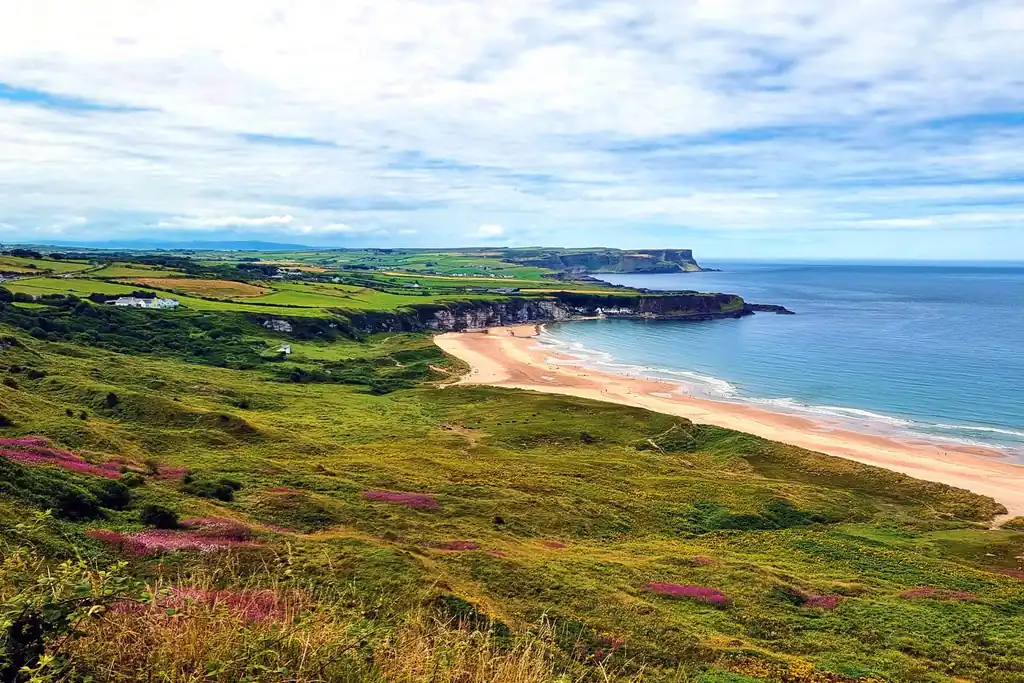
The reason for all that careful grazing is what grows here. White Park Bay is an Area of Special Scientific Interest, declared on 22 July 1996, covering 87.74 hectares and running about 400 metres inland from the mean low tide mark.
The dunes and the chalk grassland behind the beach carry a run of rare plants, orchids among them, of a kind you simply do not get on a managed amenity beach. There are sea stacks, natural arches and a large land-slipped area behind the sand, which is why the ground up there looks lumpy and unfinished rather than smooth.
There is also a bee. The Northern Colletes is a rare solitary bee that breeds in coastal habitats like this one from mid June to late August, and the National Trust notes that as much as half of the European population is concentrated in the UK, on this north coast and in the Scottish western isles. If you are here in July and the dunes are humming, that is what you are listening to.
This is one of the better fossil beaches in Northern Ireland, and it is an accident of geology. Two entirely different rock systems meet here. Underneath is Lower Jurassic mudstone, the Waterloo Mudstone Formation, grey and glutinous with bands of limestone nodules, laid down around 200 million years ago. Above it, separated by a major break in the record, sits a thin band of Hibernian Greensand and then the Upper Cretaceous chalk of the Rathlin Basin, roughly 100 to 80 million years old. That chalk is what gives the headlands their colour, and one of its bands, the Oweynamuck Flint Bank, is named after the very stretch of shore you walk to.
Which way to turn. Coming off the footpath onto the sand, the chalk cliffs, the wave cut platforms and the boulder fields are to your left. Most people who know the beach turn right instead and head east towards Oweynamuck, because that is where the Jurassic mudstone is exposed. Much of it is buried under landslipped chalk and blown sand, so it shows best at low tide and after scouring weather, in the toes of the landslips and around Oweynamuck itself.
What you will find. The chalk gives up belemnites above all, along with sea urchins and Inoceramus bivalves, usually inside loose blocks and pebbles. The Jurassic mudstone gives ammonites, the thick curved oyster shells called Gryphaea, brachiopods and gastropods. The ammonites are often pyritised, which makes them beautiful and very fragile. The bivalves come out far more easily.
One warning if you have hunted fossils in England: the chalk here is much harder than the soft chalk of the south east, and it does not split obligingly.
How to do it properly. The cliffs and the bedrock are protected as an Area of Special Scientific Interest and must not be hammered. Collect from loose fossils lying on the sand and from blocks that have already come down. That is where the good material is anyway.
The same cliffs carry flint nodules, which is why people have been coming here for ten thousand years. White Park Bay was a working site for flint axes and arrowheads, with material going back to around 8,000 BC. A fossil and a worked flint flake in the same afternoon is a good day out.
Tides and safety. The sea reaches the cliffs at high tide, so work a falling tide and know when it turns. The stone steps get slippery after rain. You will also see the odd path worn along the clifftop above the sand. None of those are marked or made up, some are plainly dangerous, and none of them are worth it.
On the hillock above the eastern end of the bay there is a burial cairn, and it is a scheduled historic monument. The record describes a sub circular mound with a domed profile, 19.1 metres north to south by 24.3 metres east to west at the base, and 5.2 metres high at its northern side. It is Bronze Age.
It was dug into in 1870, and a field inspection in 1993 recorded at least fifteen slabs and boulders still embedded in the mound. Locally it is called Knocknagalliagh, the Hag’s Hill. It is one of a run of ancient sites along this shore, much like the ones we pass on the Dark Hedges and inland runs.
You can stand on that hill and see the whole bay at once, which is presumably exactly why somebody chose it three and a half thousand years ago.
From the beach you can turn east and walk just under a mile to the far end of the bay, then continue beyond the chalk headland to Ballintoy Harbour, roughly another mile. That is the walk we would recommend if you want a proper morning out of it, and it ends at a tea room and toilets rather than back up those steps.
Two warnings. The section past the headland depends on the tide and you need to time it, and at the time of writing the National Trust has a live notice on the bay: “Unstable cliff face due to rockfall between White Park Bay and Portbradden. Please avoid the area and only attempt crossing along the beach at low tide.” That notice applies to the walk west towards Portbraddan, not the one east to Ballintoy, but it tells you what kind of coast this is.
Out to sea, watch for gannets diving and sandwich terns working the water. On the sand itself, ringed plover nest here, which is another reason the dogs stay on leads.
Summer, and early or late in the day. Murat’s answer to this is simply summer, and he is right: the dunes are at their best, the bee is out, and the light off that much pale sand is extraordinary.
But the car park is small, so the middle of a warm weekend afternoon is the one time to avoid. First thing in the morning you can have the whole two kilometres to yourself. Late afternoon into evening gives you the sun going down the length of the bay, which is when it looks the way it does in every photograph you have seen of it.

Opening times. The bay is open dawn to dusk and the car park is open all day, all year.
Guide prices. Free. No admission, no ticket, and the National Trust car park is free too.
Facilities. None at all. No toilets, no cafe, no shop. The nearest toilets and tea room are at Ballintoy Harbour, and there are more at Bushmills, where the Old Bushmills Distillery is, and at Ballycastle.
Where it is. Whitepark Road, County Antrim, on the A2 Causeway Coastal Route, signposted, about ten kilometres from Ballycastle and two from Dunseverick. The National Trust gives it as 6.5 miles from Bushmills. By bus, the Causeway Rambler, Ulsterbus 172 and 402, between Coleraine and Ballycastle.
Access. Steep stone steps and a rough laneway down to the sand. Not suitable for wheelchairs or pushchairs. The viewpoint at the car park is level and needs no descent.
What is nearby. Ballintoy Harbour and Carrick-a-Rede two minutes east, Dunseverick Castle two minutes west, and the Giant’s Causeway about ten minutes further on.
On a tour day we use White Park Bay as a viewpoint rather than a beach. It sits neatly between the big names, ten minutes from the Giant’s Causeway and a couple of minutes from Ballintoy, and because it needs no ticket and no booking it is the easy thing to drop into a day that is otherwise governed by timed entry slots.
We stop at the top, where the whole bay is laid out in front of you and the photographs are as good as anything you will get from the sand. Guests who want the full descent are better doing it on their own time, with a morning to spare and no minibus waiting.
It appears on our Giant’s Causeway tour from Belfast and on the longer Causeway Coastal Route run, and it is a regular stop on our Belfast shore excursions when a ship gives us a full day.
Yes. There is no admission charge and the National Trust car park is free too. It is small though, with no overflow, so it fills on warm summer afternoons.
No. The National Trust warns of dangerous rip currents and there is no lifeguard service. Come here to walk and to look for fossils, and swim at a lifeguarded beach.
The land above the beach is grazed under a nature conservation agreement, and the cattle wander down onto the sand. The grazing keeps the grass short, which is what allows the rare dune plants to survive.
Yes, on a lead. Since 1 April 2024 a Causeway Coast and Glens Borough Council control order has required dogs to be on leads at all times between Ballintoy and White Park Bay, with an £80 fixed penalty. There is livestock on the land and ground nesting birds on the beach.
No. There are no toilets, no cafe and no shop. The nearest toilets and tea room are at Ballintoy Harbour, with more at Bushmills and Ballycastle.
No. The National Trust describes high gradient steps and slopes down to the beach, and the path beyond them is uneven for about 1.5km. Some listing sites say otherwise and they are wrong. The viewpoint at the car park is level and gives you the whole bay.
The steep stone steps are at the start, then a winding laneway of roughly 1.5km down to the sand. Allow a good half hour down and rather longer coming back up.
Yes. Belemnites, sea urchins and Inoceramus bivalves come out of the Cretaceous chalk, and ammonites, Gryphaea, brachiopods and gastropods out of the Jurassic mudstone to the east. Collect only loose material, as the cliffs and bedrock are protected.
In the National Trust car park just off Whitepark Road, which is signposted from the A2 Causeway Coastal Route. Do not park in the youth hostel grounds. You can also park at Ballintoy Harbour and walk west over the headland, about a mile, if the tide allows.
Yes. Head east along the sand to the end of the bay, then on past the chalk headland to Ballintoy Harbour, roughly another mile. Time it with the tide.
Summer, and early morning or late afternoon. The middle of a warm weekend afternoon is when the small car park fills.
Follow us for travel inspiration, local insights, and real moments from our private tours across Northern Ireland. Stay updated with new experiences, seasonal highlights, and guest stories.
Carnlough, the Dark Hedges and the Cushendun Caves in one day, with a local guide and a private vehicle.
Filming locations on the Antrim coast in the morning, Belfast in the afternoon.
White Park Bay is one stop on a coast where nearly every headland has something behind it. These are the next places worth reading about before you drive it.
Each one is somewhere we stop, written the way we would talk you through it on the day.
Things to Do in Belfast, a Local Guide Written by Murat Yilmaz · Last updated: September 2026 I have been showing people round Belfast for nine years and the question
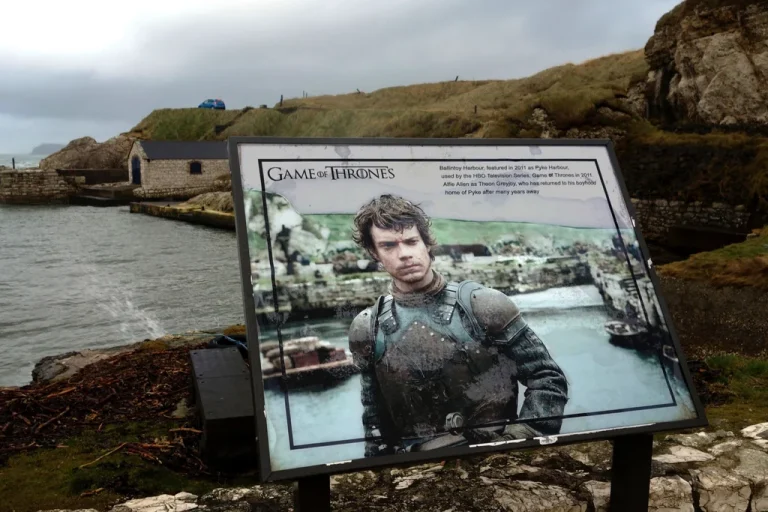
Must Visit Game of Thrones Filming Locations in Northern Ireland Written by Murat Yilmaz · Last updated: 26 September 2026 Almost every Game of Thrones filming location that people travel
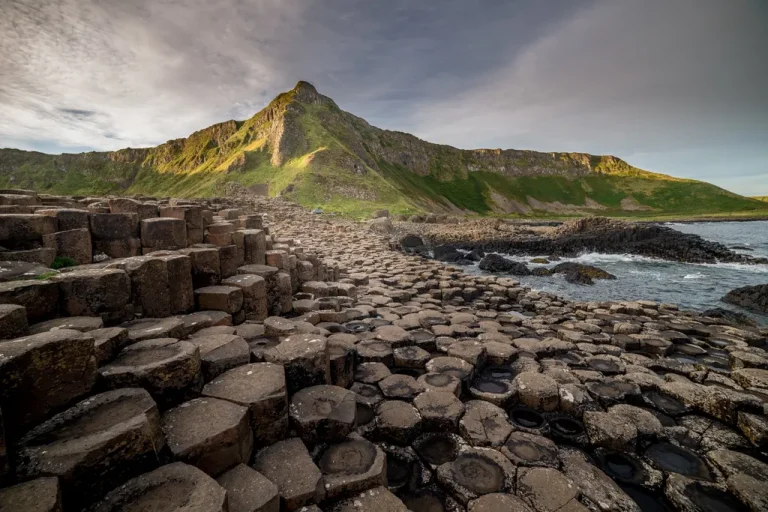
Northern Ireland Top Attractions – Must-See Places to Visit Written by Murat Yilmaz Last updated: February 23, 2026 Northern Ireland is home to some of the most iconic sights in Ireland,
Belfast Tours NI offers a range of resources to help visitors plan a trip to Belfast, Northern Ireland. Our blog post highlights the best things to do in the area and provides insider tips to ensure visitors have an unforgettable experience.
We encourage you to explore our social media channels as well, where you can find additional information and travel inspiration. Trust our team of experts to guide you through the planning process and provide you with the tools you need to fully immerse yourself in the culture and attractions of Ireland.