

Ballygally, Where the Antrim Coast Road Opens Up to the Sea
Leave Larne behind on the A2, round the bend at Drains Bay, and the Antrim Coast Road opens out in front of you, with the sea on your right and the hills rising on your left. A few minutes later you are in Ballygally, a small village about three miles north of Larne with a sandy bay, a free car park and a castle built in 1625 standing right on the roadside. Ballygally beach holds an Excellent bathing water rating, and above the village the land climbs to the basalt cliffs of Sallagh Braes.
People have lived around this bay for a very long time. Excavations in the 1990s found the remains of several Neolithic houses close to the shore. The village today is gathered around Ballygally Castle, built by James Shaw from Scotland, and the Coast Road that was blasted along the foot of these cliffs between 1832 and 1842.
There are a few things to know before you stop. Dogs must be on a lead on the beach at the busiest times in summer, the public toilets close earlier in winter, and the castle is a working hotel rather than a museum. Carnfunnock Country Park, just south of the village, is closed for redevelopment.
I drive this coast most weeks of the year, and Ballygally is where I feel the day up the coast really begins. In this guide I cover the beach and its rules, the history and ghost story of Ballygally Castle, Ballygally Head, Sallagh Braes and Cairncastle above the village, the Antrim Coast Road itself, and what is nearby, from Carnfunnock to Glenarm, Carnlough and The Gobbins.
Table of Contents
ToggleBallygally Beach, the First Sand on the Antrim Coast Road
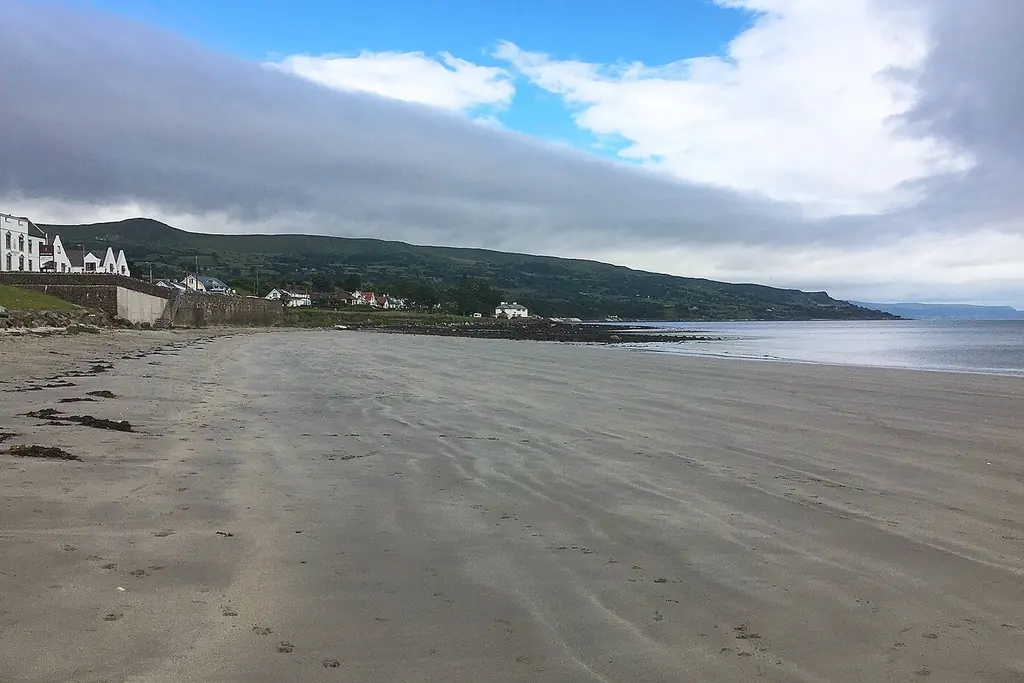
Ballygally beach is a short sandy bay with seaweed and boulders at either end. The official tourism listing describes views in every direction: north along the Antrim coast, east across the sea to Scotland, south to Ballygally Head and west inland to Scawt Hill and Sallagh Braes. It is the first stretch of sand you reach on the Coast Road north of Larne, and a natural place to pull in.
Getting onto Ballygally beach
Access is straightforward. A sloped path leads to a level wooden platform at the main entrance, and there are steps about 110 yards along the beach and more steps from the Ballygally Castle Hotel car park at the far end. Near the main entrance there is a viewpoint with seating that is fully wheelchair accessible, which makes it a good stop for anyone who would rather look at the sea than walk on it.
Parking and toilets at Ballygally beach
There is a free council car park across the road from the beach, and public toilets with baby changing at the far end of it. Next to the car park there is a shop selling refreshments and ice cream, and the castle hotel is right beside you. For children, there is a play park at the junction of Croft Road and Cairncastle Road, a short walk from the beach.
The Coast Road runs right along the back of the beach, so take care crossing from the car park, especially with children. Traffic on the Coast Road can move quickly, and drivers are often looking at the view rather than the road.
How long to spend at Ballygally beach
Twenty minutes is enough for a walk along the sand and a look at the castle. If you have a picnic, a dog or children who want to play on the beach, an hour passes very easily. It is also a handy place to use the toilets before the long run north to Glenarm and Carnlough.
Visitor information
Opening times. Open access to the beach all year round. The public toilets open 9am to 9pm from April to September and 9am to 4.30pm from October to March.
Guide prices. Free. The car park is free.
Booking. No booking needed.
Facilities. Free car park, public toilets and baby changing, a shop for refreshments and ice cream, a wheelchair accessible viewpoint with seating, and a children’s play park at the Croft Road and Cairncastle Road junction.
Where it is. Coast Road, Ballygally, County Antrim, BT40 2QZ. About 26 miles from Belfast by road, taking the A8 to Larne and the A2 Coast Road north for about three miles. The nearest railway station is Larne, on the Larne line from Belfast.
What is nearby. Ballygally Castle, Carnfunnock Country Park walking trails, Sallagh Braes and Glenarm.
Dogs, Swimming and Water Quality at Ballygally Beach
Ballygally draws dog walkers and swimmers all year, and both come with a few rules worth knowing. None of them are complicated, but the dog rule is the one to remember in summer.
Is Ballygally beach dog friendly?
Yes, dogs are welcome, with one seasonal restriction. Under Mid and East Antrim Borough Council’s dog control orders, dogs must be kept on a lead no longer than 6 feet on Ballygally beach from 1 June to 31 August, between 11am and 6pm every day, including public and bank holidays. Outside those hours and months there is no lead order on the beach.
Dog fouling is an offence on any land open to the public, and breaching any dog control order can bring a £120 fixed penalty, or a fine of up to £1,000 if it goes to court. Dogs are not allowed in any of the council’s children’s play parks, which includes the one at the Croft Road junction.
Is Ballygally beach safe to swim?
The water quality is very good. Ballygally is an identified bathing water, and in DAERA’s 2025 results it was classified as Excellent, the highest of the four grades. The classification is based on samples taken over the previous four years.
Water quality is not the same as safety, though. I have found nothing official to say the beach has lifeguard cover, so do not assume there is anyone watching. DAERA also advises against bathing during, or for up to 48 hours after, heavy or prolonged rain, because run off can affect the water. Check the forecast and the sea conditions before you go in, and keep an eye on children at all times.
Ballygally beach tide times
This is a short beach, so the state of the tide makes a real difference to how much sand you have to walk on. If a long walk or a game on the sand matters to you, it is worth checking a tide table before you set off. Tide tables for nearby Larne are published widely online.
Ballygally Castle, a 1625 Tower House Still in Use
Ballygally Castle sits in the middle of the village, right on the Coast Road at the junction with the road to Cairncastle. It was built in 1625 by James Shaw, a Scotsman who rented the land from Randal MacDonnell, the 1st Earl of Antrim. The hotel describes it as Northern Ireland’s only 17th century castle still in use as a residence, and it is a listed building.
The history of Ballygally Castle
The castle is a Scottish style tower house of four storeys, with walls about five feet thick and turrets at the corners of the roof. Over the main door you can still read the old Scots inscription, Godis Providens is my Inheritans. It was built to defend, and during the rebellion of 1641 the Irish garrison at Glenarm tried several times to take it, without success.
The Shaw family held Ballygally for almost two centuries. In 1799 it passed to William Shaw, the last squire, and the family’s money ran out soon afterwards. The castle passed through several hands, including a spell as a coastguard station. In the 1840s the side of the old walled enclosure nearest the sea was removed to make way for the new Coast Road. In the early 1950s the textile businessman Cyril Lord bought it and turned it into the hotel you see today.
Visiting Ballygally Castle today
Ballygally Castle is a hotel run by the Hastings Hotels group, with a bar, a restaurant and afternoon tea, so you visit it as a hotel guest or a diner rather than with a ticket. From the beach and the Coast Road you get the best view of the old tower, with its turrets rising above the newer wings. If you would like to eat there or stay, the Ballygally Castle Hotel takes bookings directly.
Visitor information
Opening times. A working hotel, open all year to residents and diners. The exterior can be seen from the beach and the Coast Road at any time.
Guide prices. No admission charge to see the castle from outside. Food and rooms are priced by the hotel.
Booking. Book meals, afternoon tea and rooms directly with the hotel on +44 28 2858 1066.
Facilities. Hotel bar, restaurant and afternoon tea. Free council car park and public toilets across the road at Ballygally beach.
Where it is. Ballygally Castle, Coast Road, Ballygally, County Antrim, BT40 2QZ. About 26 miles from Belfast by road, on the A8 to Larne and then the A2 Coast Road. The nearest railway station is Larne.
What is nearby. Ballygally beach, Sallagh Braes and Cairncastle, Carnfunnock Country Park walking trails and Glenarm.
The Ballygally Castle Ghost Story and the Game of Thrones Door
Ballygally Castle has long had a reputation for being haunted, and it is reputed to be one of the most haunted places in Ulster. It is a story, and I tell it as one, but it is a good one.
The story of Lady Isabella Shaw
The tale goes like this. James Shaw wanted a son and heir. When his wife, Lady Isabella, gave birth to a daughter instead, he locked her in a room at the top of the tower. She tried to escape through the tiny window to reach her baby, and fell to her death on the rocks below. Since then, the story says, she has walked the castle.
Hotel visitors and staff over the years have described sudden drops in temperature, a sense of heaviness in the old turret room and shadows in the corners. None of it can be proved, and none of it needs to be. What is real is the room itself, at the top of a steep spiral stair, with a small window looking out over Ballygally Bay.
The ghost room at Ballygally Castle
The turret room is known as the ghost room. According to a 2025 report in The Irish Times, it is no longer used for overnight stays, but visitors can see it during the day. If you would like to take a look, ask at the hotel reception first, as it is part of a working hotel.
Game of Thrones Door 9 at Ballygally Castle
Ballygally Castle also holds one of the ten carved Game of Thrones doors. When Storm Gertrude brought down beech trees at the Dark Hedges in 2016, the wood was carved into ten doors, one for each episode of season six, and placed in pubs and hotels around Northern Ireland. Door 9 is here at Ballygally. You can find the full trail in our guide to Game of Thrones filming locations.
Ballygally Head, the Volcanic Headland South of the Bay
Look south from the beach and the skyline is filled by Ballygally Head, a dark headland that drops straight into the sea. The Coast Road curves round its foot on the way from Drains Bay, so you pass right beneath it on the way into the village.
How Ballygally Head was formed
Ballygally Head is a volcanic plug, the cooled remains of the pipe of an ancient volcano. Geologists have found wedges of broken volcanic rock around it, which show that it erupted in several stages before the vent filled with molten rock for the last time. In places there are tall columns like the ones at the Giant’s Causeway, but these are dolerite rather than basalt. Dolerite is a similar rock that cooled more slowly inside the volcano, so its crystals had time to grow larger.
Inland, Scawt Hill is another volcanic plug, about three miles west north west of the village. It is a protected Area of Special Scientific Interest because of the rare minerals found there, and six minerals were discovered there for the first time, including scawtite and larnite.
Where to see Ballygally Head
Ballygally Head is best seen from the beach or from the road as you drive round it. The top of the headland is home to Cairndhu Golf Club, so the best views of it are from below. If you are planning a golf trip, our private golf tours can build a round here into a longer day on the coast.
For anyone interested in how this coastline was formed, Ballygally Head is a good introduction before you reach the Giant’s Causeway. The same volcanic story runs all the way along the Antrim coast, and our guide to the Giant’s Causeway picks it up at the other end.
Sallagh Braes and Cairncastle, the Lands Around Winterfell
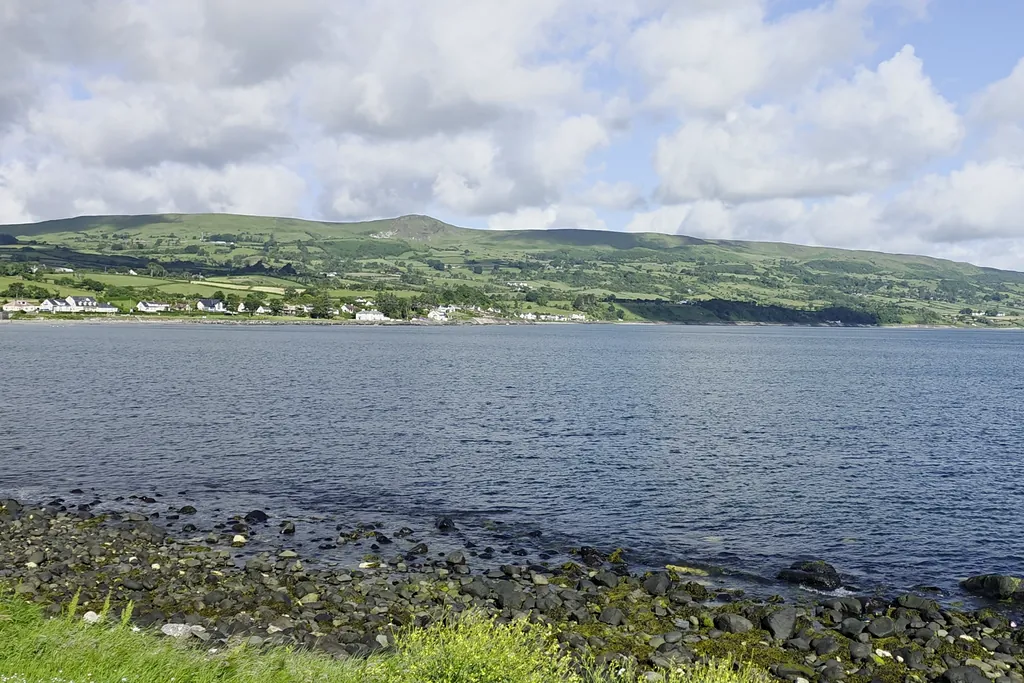
Turn inland at the castle and take the Cairncastle Road, and within a few minutes the land climbs into a different world. Above Cairncastle lies Sallagh Braes, a vast curving amphitheatre of basalt cliffs around a green bowl of farmland. It is one of the most dramatic inland landscapes in County Antrim, and most people driving the coast below never know it is there.
Sallagh Braes in Game of Thrones
This countryside stood in for the lands around Winterfell. It was near here that Ned Stark beheaded the Night’s Watch deserter in the very first episode. Discover Northern Ireland also names Sallagh Braes as the place where Brother Ray built a septry with the help of the Hound. You will find interpretation panels about the filming in the car park.
The Sallagh Braes walk
The walk starts at Linford car park on Feystown Road, crossing a stile at the south end. It is 1.8 miles and graded moderately difficult, starting from a height and rolling across hummocky ground with some hills to climb. It follows the Ulster Way and Antrim Hills Way waymarkers along the rim of the escarpment, with views across the cliffs to the valley below and out to the Irish Sea.
Discover Northern Ireland points out a neolithic burial site along the way and a valley of bluebells in spring. Dogs are not allowed on this walk at all, because the path crosses farmland grazed by sheep. There are no toilets at the car park, so use the ones at Ballygally beach before you drive up.
Getting to Sallagh Braes from Ballygally
From Ballygally, take the Cairncastle Road, turn right onto Drumnagreagh Road, left onto Ballycoose Road, and then follow Feystown Road for about two miles to Linford car park. The roads are narrow and climb steeply, so take your time. The Game of Thrones tour page shows how these hills fit into a day of filming locations.
Visitor information
Opening times. Open access countryside, with no published hours.
Guide prices. Free. Linford car park is free.
Booking. No booking needed.
Facilities. Car park with Game of Thrones interpretation panels. No toilets and no café. Dogs are not allowed on the walk.
Where it is. Linford car park, Feystown Road, Ballygally, County Antrim, BT40 2LZ. From Ballygally take the Cairncastle Road, Drumnagreagh Road and Ballycoose Road, then about two miles on Feystown Road.
What is nearby. Ballygally beach and Ballygally Castle, Glenarm, and Carnlough Harbour.
The Antrim Coast Road, Built Along the Foot of the Cliffs
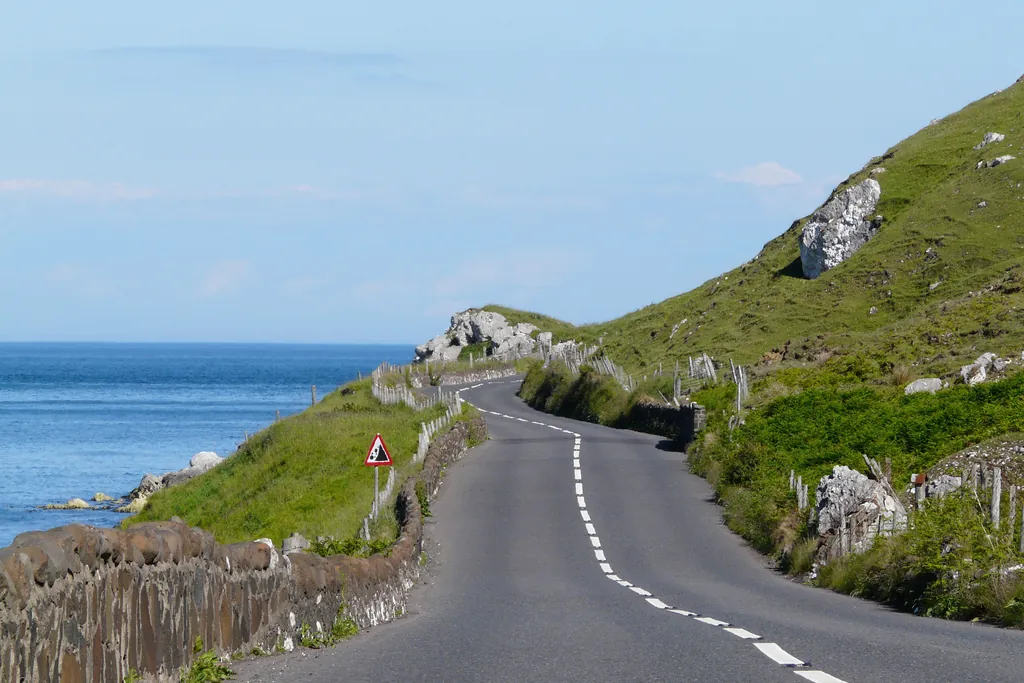
Ballygally sits on one of the great coastal drives of these islands, and it is worth knowing how the road came to be here. Before the 1830s, the way north from Larne meant climbing over each headland and dropping into each glen, with steep hills the whole way. The Antrim Coast Road changed that by running along the very edge of the sea.
William Bald, the engineer who built the Coast Road
The road was promoted by the Commissioners of Public Works, but the idea of building it along the foot of the cliffs came from their civil engineer, William Bald. He built it between 1832 and 1842. Rather than cutting a ledge, Bald blasted the cliff face so that the rock fell onto the foreshore and formed the base for the new road.
The road was finished in 1842 at a cost of £37,140, some £12,000 over budget. It then stayed largely unchanged until the late 1960s, when major rockfalls south of Glenarm led Antrim County Council to build a new stretch further out on the seaward side. That work was completed in November 1970. A small plaque to Bald stands on the road just north of Larne.
Driving the Antrim Coast Road today
Today the Antrim Coast Road is part of the A2 and the Causeway Coastal Route. North of Ballygally it runs under the cliffs to Glenarm and Carnlough, then on past the Glens of Antrim towards the north coast. The road is good, but it is narrow in places, with tight bends where it squeezes between cliff and sea, so let faster traffic past and use the lay-bys for your photographs.
If you want the whole road in one day, it leads all the way to the Giant’s Causeway. Our Giant’s Causeway tour follows this route north, and Ballygally is the natural first stop.
Carnfunnock Country Park, Closed for Redevelopment
Just south of the village, on the Coast Road towards Larne, is Carnfunnock Country Park, 191 acres of woodland, gardens and coast. For years it was the natural partner to a stop at Ballygally, with its maze, walled garden, play park and caravan park. At the moment, though, it is closed.
Carnfunnock closure and what is still open
The park closed for a major redevelopment, and the works started on 7 July 2025. Mid and East Antrim Borough Council states that all facilities, including the car park, visitor centre, play park and caravan park, are closed. No reopening date has been published. Local reporting in September 2026 described the new visitor centre and amenity block as being at an advanced stage.
The walking trails are still open on foot, and the dog exercise area remains accessible. You park outside the park, at Drains Bay, which has parking and public toilets, or at Carnfunnock Bay. Drains Bay was recently added as a new identified bathing water, so it is a pleasant stop in its own right.
What the new Carnfunnock Country Park will include
The council has secured £6.1 million from the UK Government for the project. The plans include a new visitor centre with a café overlooking the coast, a fully inclusive adventure play park, a bike park with a pump track and jump trail, an elevated viewing platform over the maze, and a new amenity block with toilets. Once it reopens, Carnfunnock and Ballygally together will make an easy half day for families.
Until then, Ballygally beach is the better stop for most people. It has the parking, the toilets and the shop that Carnfunnock is missing during the works.
Visitor information
Opening times. Closed for redevelopment since July 2025, with no reopening date published. Pedestrian access to the walking trails and dog exercise area remains.
Guide prices. Free pedestrian access.
Booking. No booking needed for the walking trails.
Facilities. Park car park, visitor centre, play park and caravan park closed. Parking and public toilets at Drains Bay, 158 Coast Road, open 9am to 9pm from April to September and 9am to 4.30pm from October to March. Parking also at Carnfunnock Bay.
Where it is. Coast Road, Ballygally, Larne, County Antrim, BT40 2QG. On the A2 Coast Road between Larne and Ballygally, about a mile south of Ballygally beach. The nearest railway station is Larne.
What is nearby. Ballygally beach and Ballygally Castle, Larne Promenade, and Ballygally Head.
Glenarm, Carnlough and The Gobbins, Nearby Stops
Ballygally is rarely the only stop in a day, and the places around it are worth knowing. North along the Coast Road are two of the prettiest villages on the Antrim coast, and south of Larne is one of the most unusual walks in Ireland.
Glenarm, seven miles north of Ballygally
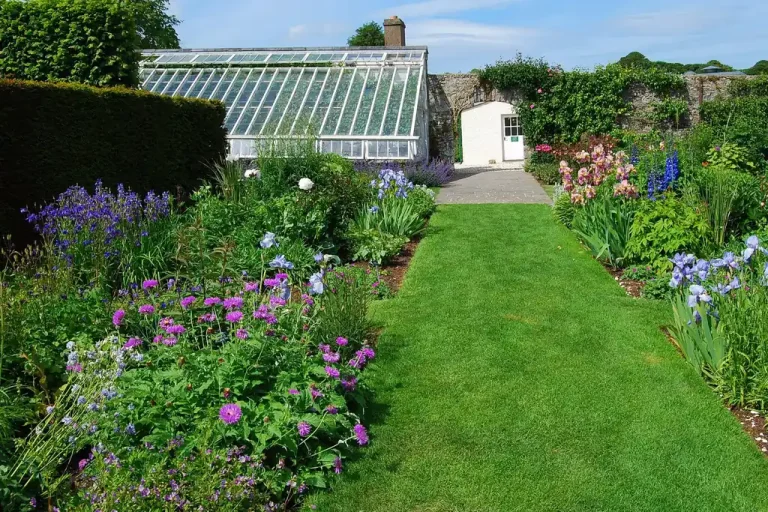
About seven miles north of Ballygally is Glenarm, a handsome Georgian village at the mouth of its glen. It is home to Glenarm Castle and one of Ireland’s oldest walled gardens, and the Layde Walk above the village gives fine views over the bay. There are public toilets at 2 The Cloney, open 9am to 9pm from April to September and 9am to 4.30pm in winter.
Carnlough Harbour, a few miles further north
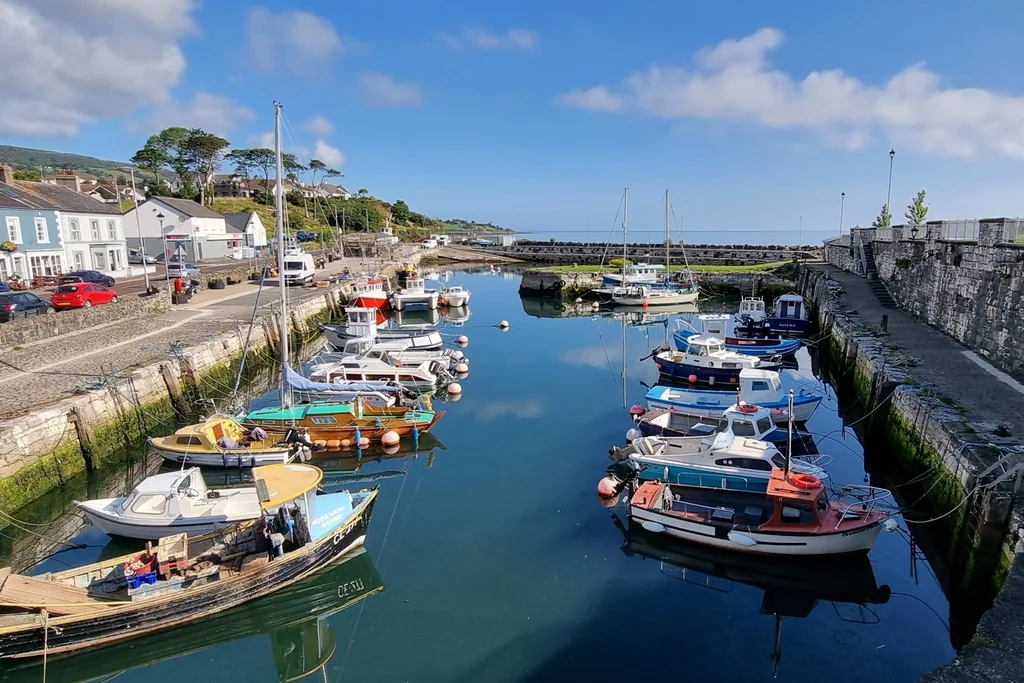
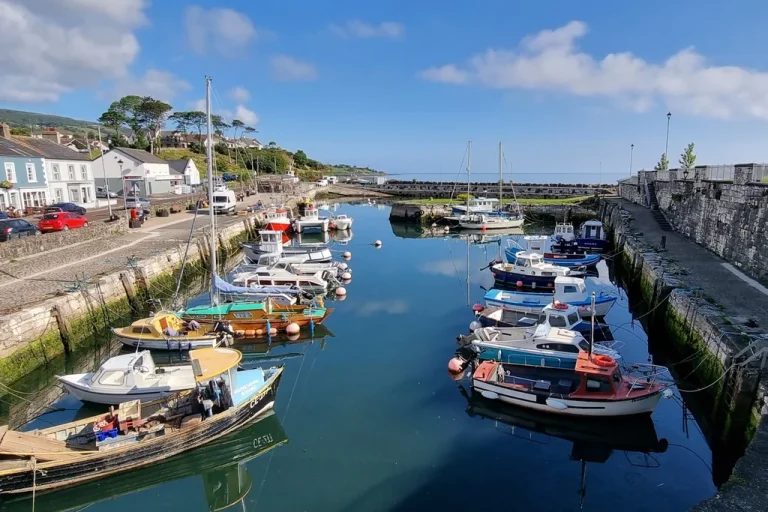
A few miles further on is Carnlough, with its harbour and long harbour wall. It appeared in Game of Thrones as a canal in Braavos, and it is a good place for lunch and a stroll. Our guide to Carnlough Harbour has the details, and if you have time to head inland from there, Glenariff Forest Park is one of the finest of the Glens.
The Gobbins cliff path at Islandmagee
South of Larne, on the Islandmagee peninsula, The Gobbins is a cliff path built by the railway engineer Berkeley Deane Wise, with bridges and tunnels along the face of the cliffs above the sea. It can only be walked on a booked guided tour, and it is physically demanding, 3 miles long with many uneven steps. It reopened on 20 March 2026 after storm damage closed it in 2025. If you are thinking of combining it with Ballygally, book the tour first and plan the rest of the day around your time slot.
Visitor information
Opening times. Visitor centre open 8.30am to 5pm daily in season. Tours run at set times and may close for safety in bad weather.
Guide prices. Online prices: adult aged 16 and over £23.50, child under 16 £17.50, concession aged 65 and over £17.50 from Monday to Thursday only, family of 2 adults and 2 children £52.50.
Booking. Booking in advance is essential to guarantee a place on a tour.
Facilities. Visitor centre with parking, toilets, café, gift shop, free lockers and boot hire. Walking boots are required, and anyone under 4 feet tall is not permitted on the path.
Where it is. The Gobbins Visitor Centre, Middle Road, Islandmagee, County Antrim, BT40 3SL. About 15 miles from Ballygally by road, back through Larne and onto Islandmagee. From Belfast, The Gobbins gives 35 to 55 minutes by car. By train, Ballycarry station is a 20 minute walk.
What is nearby. Whitehead and the Blackhead Path, Larne, and Carrickfergus Castle.
Ballygally FAQ
Is Ballygally beach dog friendly?
Yes, dogs are welcome on Ballygally beach. From 1 June to 31 August they must be on a lead no longer than 6 feet between 11am and 6pm, and outside those times there is no lead order on the beach.
Is Ballygally beach safe to swim?
The water quality is rated Excellent in DAERA’s 2025 results. There is no official information about lifeguard cover, so do not assume there is any, and avoid swimming for up to 48 hours after heavy rain.
What is the Ballygally beach water quality?
Ballygally was classified as Excellent in DAERA’s 2025 bathing water results, the highest of the four grades. The classification is based on samples from the previous four years.
Is there parking at Ballygally beach?
Yes, there is a free council car park across the road from the beach. The public toilets and baby changing are at the far end of the car park.
Are there toilets at Ballygally beach?
Yes. The public toilets at the Ballygally free car park open 9am to 9pm from April to September and 9am to 4.30pm from October to March.
Is Ballygally Castle haunted?
It has a reputation as one of the most haunted places in Ulster. The story is that Lady Isabella Shaw fell to her death from the turret room while trying to reach her baby daughter, and that she still walks the castle.
What is the ghost room at Ballygally Castle?
It is the small turret room at the top of the tower, linked to the story of Lady Isabella Shaw. It is no longer used for overnight stays, but visitors can see it during the day, so ask at reception first.
Can you visit Ballygally Castle?
Yes, as a hotel guest or diner. Ballygally Castle is a working hotel with a bar, restaurant and afternoon tea, and you can see the old tower from the beach and the Coast Road at any time.
How old is Ballygally Castle?
Ballygally Castle was built in 1625 by James Shaw from Scotland. The hotel describes it as Northern Ireland’s only 17th century castle still in use as a residence.
Is Ballygally Castle dog friendly?
No. The hotel’s booking listings state that pets are not allowed to stay. If you are travelling with an assistance dog, contact the hotel directly before you book.
Is Ballygally in Larne?
Ballygally is a separate village about three miles north of Larne, in the Mid and East Antrim Borough Council area. It uses a Larne postcode, BT40.
How far is Ballygally from Belfast?
Ballygally is about 26 miles from Belfast by road, via the A8 to Larne and the A2 Coast Road north. The nearest railway station is Larne.
Is there a Game of Thrones location near Ballygally?
Yes. Sallagh Braes and the countryside around Cairncastle, just above the village, stood in for the lands around Winterfell, and Door 9 of the Doors of Thrones is at Ballygally Castle.
How do you get from Ballygally to the Giant’s Causeway?
Follow the Antrim Coast Road north through Glenarm, Carnlough and the Glens of Antrim to the north coast. It is part of the Causeway Coastal Route and one of the finest drives in Ireland.

Belfast Tours NI is a local tour company for travellers who want a personal, relaxed way to explore Northern Ireland, offering private tours, tailored itineraries, and local insight to help you plan a memorable visit.
Written by Murat Yilmaz · Last updated:
Keep Exploring the Antrim Coast
Glenarm Castle and Its Walled Garden
Carnlough Harbour and the Arya Stark Steps
Private Tours in Belfast and Northern Ireland
Ballygally is where many of our days up the Antrim coast first stop for the sea. With a private tour, a local guide drives you out of Belfast and along the Coast Road, with time on the beach, a look at the castle and, if you would like, the climb up to Sallagh Braes for the Game of Thrones country above the village.
From here the day can go wherever suits you, north to Glenarm, Carnlough and the Glens, or all the way to the Giant’s Causeway. We collect you from your Belfast hotel, from either Belfast airport, or from the cruise terminal. If you are starting in Dublin, our chauffeur service brings you north, and the guided part of the day begins in Northern Ireland.
Up to 7 passengers travel in a Mercedes-Benz V-Class, 8 in a Ford Tourneo Custom, and 9 or more in two V-Class vehicles travelling together. Every vehicle is licensed as a taxi and insured for passengers, and every one of our drivers holds a taxi licence.
Let us know your dates, your numbers and what you most want to see on the coast, and we will put the day together around you. Send us a message through our contact page.
Game of Thrones Tour
Visit the real Game of Thrones filming locations across Northern Ireland, including the Dark Hedges and Ballintoy Harbour, on a fully private tour.
Giants Causeway Tour
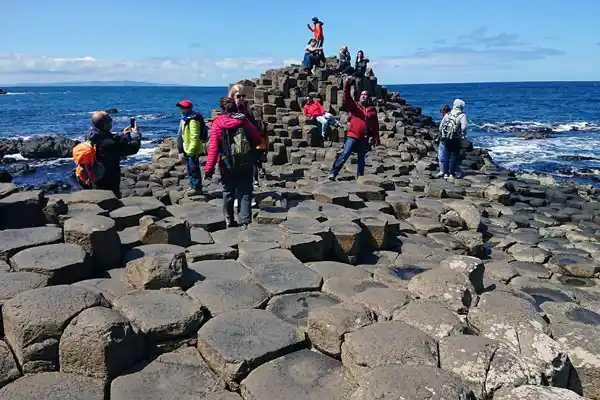
A full day at the Giant’s Causeway from Belfast, travelling the Causeway Coastal Route with your own local driver-guide and time for photos at every stop.
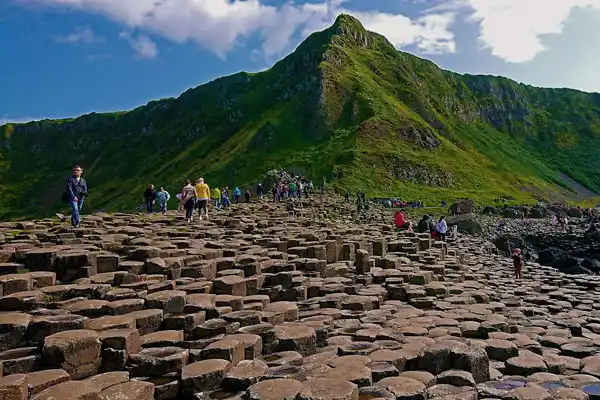
Giant’s Causeway Half Day Tour
Short on time? A private half-day run to the Giant’s Causeway and the Antrim Coast, ideal if your day in Belfast is already busy.
Planning a private tour of Northern Ireland? ➔ Get in touch to discuss your ideas.
Connect with Us
Our social channels follow the Antrim Coast Road through the year, from calm mornings on Ballygally beach to the cliffs of Sallagh Braes and the turrets of Ballygally Castle against the sea.
If you have a question about Ballygally or anywhere along this coast, send us a message on any of the channels below. It is the quickest way to reach us, and we are happy to help whether or not you travel with us.