

The Giants Causeway – A Natural Wonder of Northern Ireland
Written by Murat Yilmaz
Last updated: June
The Giant’s Causeway is undoubtedly a sight to behold, and it has been recognized as such by UNESCO, who have designated it as a World Heritage site. Located on the stunning North East coast of County Antrim, this geological formation is not only magnificent but also mysterious. The area is characterized by polygonal columns that appear to have been placed with great precision, giving rise to countless theories regarding its formation – from the mythological to the scientific.
As you explore this incredible site, you’ll have the chance to marvel at the interlocking basalt columns and incredible natural landscape. The Giant’s Causeway truly takes you on a journey through time as you explore the area and discover its fascinating history, making it a must-see destination for anyone interested in the natural world or Ireland’s rich and diverse heritage.
Table of Contents

Giants Causeway And The Antrim Coast
Planning a trip to the Giant’s Causeway? Here is everything you need to make the most of your visit. The Causeway sits on the dramatic North Antrim coast, beside the village of Bushmills in County Antrim. The full address is 44 Causeway Road, Bushmills, County Antrim, BT57 8SU, and it lies about 60 miles from Belfast — roughly an hour and a quarter’s drive along the famous Causeway Coastal Route, and only 10 minutes from Portrush and Bushmills.
Voted one of the world’s top destinations by Condé Nast Traveler readers, the Giant’s Causeway is the natural highlight of this coastline. It also sits within easy reach of some of Northern Ireland’s best-loved sights, including the Carrick-a-Rede Rope Bridge, Dunluce Castle, Old Bushmills Distillery and the Dark Hedges — which is why most visitors make a full, unhurried day of it along the coast.
Things to See at the Giant’s Causeway
The Grand Causeway – the largest and most famous collection of columns.
The Organ – a dramatic cliff formation resembling organ pipes.
The Giant’s Boot – a massive rock shaped like a boot, said to belong to Finn McCool.
Stunning Coastal Views – from dramatic cliffs to the crashing Atlantic waves.
The site also has a Visitor Centre with interactive exhibits, a gift shop, and guided tours that provide fascinating insights into both the science and myths of the Causeway.
What is the Giants Causeway?
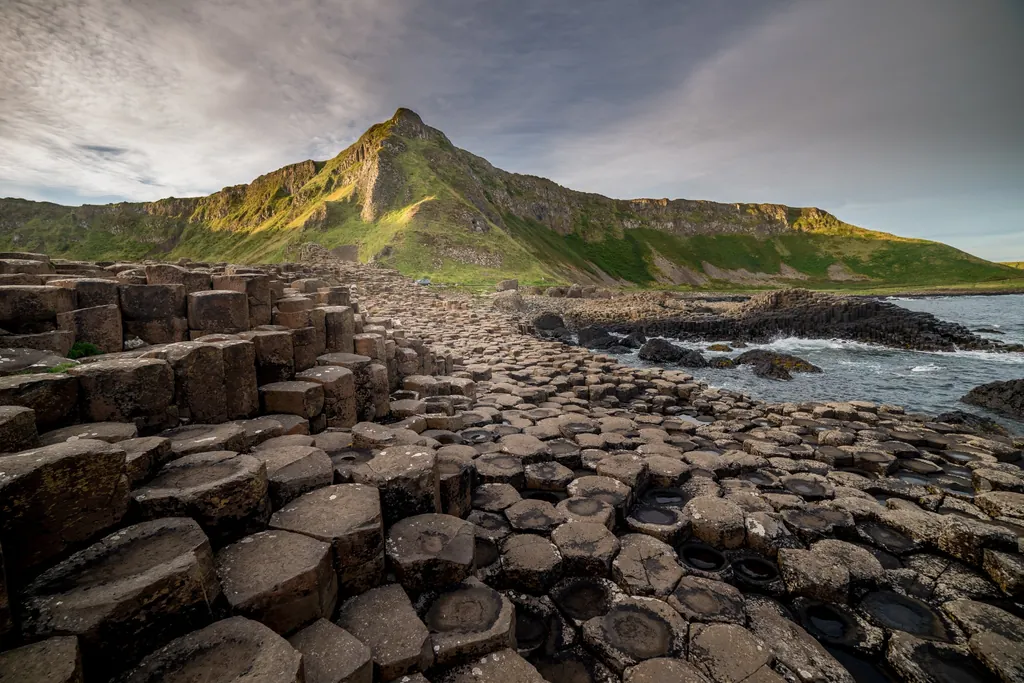
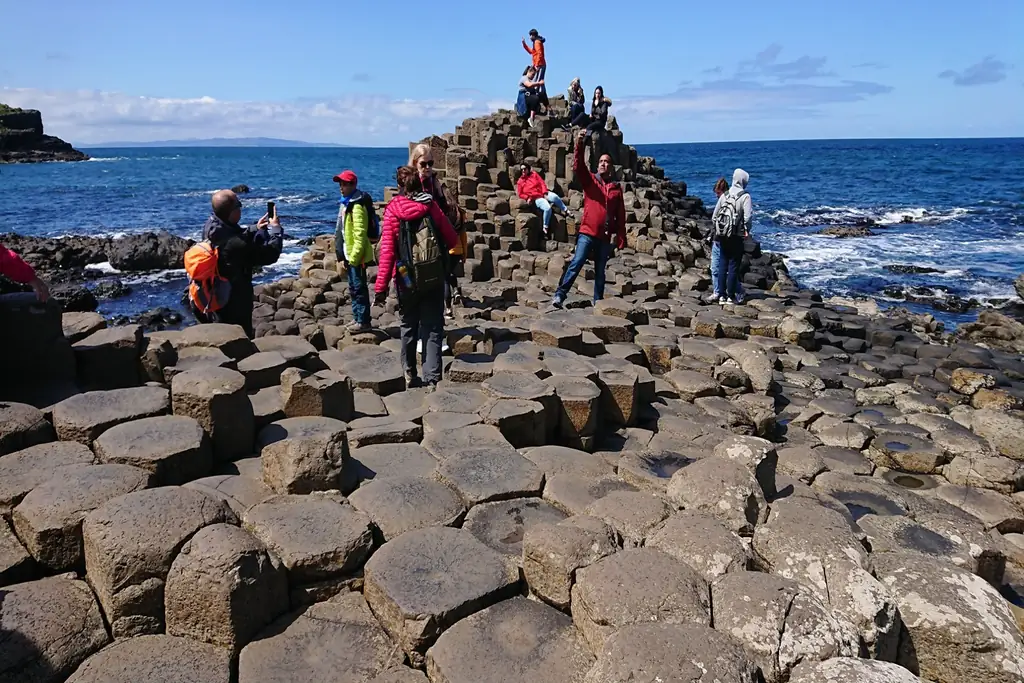
The Giants Causeway is the only UNESCO World Heritage site in Northern Ireland. Situated on the beautiful North Coast, in an area of outstanding beauty, with breathtaking views, this is a must-see for anyone travelling to Northern Ireland. Often called the Eighth Wonder of the World, the Giants Causeway is a magical, mythical and mysterious place to visit.
The Causeway lies at the foot of the basalt cliffs along the sea coast on the edge of the Antrim plateau in Northern Ireland. It is made up of some 40,000 massive black basalt columns sticking out of the sea. These geological formations were formed 50–60 million years ago during Tertiary volcanic activity, and are a major tourist attraction.
Visiting the Giants Causeway: Tickets, Parking and Practical Tips
Is it free? Yes — the stones themselves are free to visit. You can walk down to the Causeway on the public coastal path at any time of year. What you pay for is the Visitor Experience: the car park, the Visitor Centre and exhibition, an audio guide and guided storytelling. Adult tickets are usually around £14.50 (a little less booked online), with family tickets and free entry for under-5s — prices change seasonally, so check the National Trust website for the current rate.
Getting down to the stones: It is a one-mile, gently downhill walk (10–15 minutes) from the Visitor Centre to the Causeway. A shuttle bus runs between the two for a small charge (around £1 each way) if you would rather not walk back up.
Walking trails: Beyond the main viewing area there are clifftop trails that are quieter and just as beautiful — a short, easy route takes you straight to the stones, while the longer clifftop paths reward you with sweeping coastal views towards Scotland on a clear day.
How long to spend: Allow at least two hours, or half a day if you would like to walk the trails.
Best time to visit: Early morning or late afternoon for softer light and fewer people. Spring and autumn are noticeably quieter than midsummer.
What to bring: Comfortable, grippy shoes (the stones are uneven and can be slippery), warm layers, and a waterproof — the coastal weather changes quickly.
Follow Us for Tour Updates & Travel Inspiration
Follow us for travel inspiration, local insights, and real moments from our private tours across Northern Ireland. Stay updated with new experiences, seasonal highlights, and guest stories.
About Belfast Tours NI

Belfast Tours NI is a local tour company for travellers who want a personal, relaxed way to explore Northern Ireland, offering private tours, tailored itineraries, and local insight to help you plan a memorable visit.
Drive from Belfast to the Giant's Causeway
There are 3 ways to get from Belfast to Giant’s Causeway by train, bus or by car. The key stops on the way are Cushendall, Bushmills, and the Carrick-a-Rede Rope Bridge for those who wish to see it. Picking up a hire car at Belfast International Airport and driving here maybe your best option as it gives you some of the best scenery on this route and you can enjoy it. If you’re short on time or would prefer not to drive in busy traffic, then booking a private tour may also be an option.
There are two driving routes to get to Giants Causeway from Belfast. The first is a spectacular coastal scenic route that goes from Belfast to Giant’s Causeway. The alternative is to take the motorway which is a faster way of getting there.
Belfast to The Giants Causeway By train
if you are on a budget your best bet would be via train from Belfast Central Station to Coleraine and then a bus to the Giant’s Causeway (you can find the timetables on the Translink site. unfortunately, this means you will miss the beautiful Antrim Coast but public transport via this route takes almost 3.5 hours!
From Belfast’s Great Victoria Street, take the train to Coleraine. The journey should last about 1 hour and 15 minutes. When you arrive in Coleraine, get either the 170 or 420 bus, both of which run directly to the Causeway.
Taking a combination of train and bus is a more scenic way of getting from Central Belfast to Giant’s Causeway. The first leg of the journey involves taking a train from Belfast to Coleraine Train Station, which takes around 1hr20m. From here, take the Ulsterbus Service 172 which goes to Giants Causeway. The prices of bus and train tickets vary but normally work out costing more than taking a tour or direct bus.
Geology How was the giant's causeway formed
Around 50 to 60 million years ago, during the Palaeocene Epoch, Antrim was subject to intense volcanic activity, when highly fluid molten basalt intruded through chalk beds to form an extensive volcanic plateau. As the lava cooled, contraction occurred.
Horizontal contraction fractured similarly to drying mud, with the cracks propagating down as the mass cooled, leaving pillarlike structures, which also fractured horizontally into “biscuits”. In many cases, the horizontal fracture resulted in a bottom face that is convex, while the upper face of the lower segment is concave, producing what are called “ball and socket” joints.
The size of the columns was primarily determined by the speed at which the lava cooled. The extensive fracture network produced the distinctive columns seen today. The basalts were originally part of a great volcanic plateau called the Thulean Plateau, which formed during the Palaeocene.
Tour from Belfast to giant's causeway
The best and most convenient way to get there is by private tour, which travels along the Antrim coast and stops at many top tourist attractions on the way to the Giant’s Causeway.
There are many tours that depart daily from Belfast and Dublin to Giants Causeway. Some of these tours only visit the Giant’s Causeway and the nearby Carrick-a-Rede rope bridge. Others will spend less time at Giant’s Causeway but include stops at nearby attractions such as the Game of Thrones filming locations.
Several bus companies offer scheduled services daily on these routes, but taking a private tour offers more personalised service, and you will get to see places that aren’t mentioned in the regular bus tour.
For all your Belfast day trip needs, a Private Tour is an excellent choice. If you are looking for a more personal experience of the Giant’s Causeway and the Antrim coast private tour is the best option to have an unforgettable day trip from Belfast with Belfast Tours NI
A private day trip from Belfast can be a great experience to enjoy a different side of the Antrim coast. You will be visiting Giant’s Causeway, Carrick-A-Rede rope bridge, and Causeway coast which are all located in County Antrim.
The picturesque drive takes you to the beautiful North Antrim region of Northern Ireland and the most popular tourist attractions. This drive takes you through some very picturesque areas of Northern Ireland and exposes you to some fascinating sites along the way.
What's Nearby: Exploring the Causeway Coast
One of the joys of the Giant’s Causeway is everything around it. Within a short drive you will find some of Northern Ireland’s most memorable places, which is why we build a full, unhurried day around the coast:
- Old Bushmills Distillery — the world’s oldest licensed whiskey distillery, about 5 minutes away.
- Dunluce Castle — dramatic clifftop ruins, around 8 minutes along the coast.
- Carrick-a-Rede Rope Bridge — the famous rope bridge over the Atlantic, about 15 minutes east.
- Ballintoy Harbour & White Park Bay — a picturesque harbour (a Game of Thrones location) and a sweeping sandy beach, 10–12 minutes away.
- Dunseverick Castle & Portbradden — quiet, scenic spots just minutes from the Causeway.
- The Dark Hedges — the iconic beech-tree avenue, about 20 minutes inland.
- Portrush & Whiterocks Beach — a lively seaside town and a beautiful limestone beach, around 12 minutes away.
- Mussenden Temple & Downhill Demesne — a clifftop temple with breathtaking views, about 25 minutes west.
You can comfortably combine several of these with the Causeway in a single day — and on our private Giant’s Causeway tour from Belfast we do exactly that, at a relaxed pace with door-to-door pickup.
Giants Causeway Story and Legend
There are some who will try to tell you that the Giant’s Causeway was built by volcanoes, claiming that 63 million years ago, in Ireland, or Northern Ireland at least, was on fire with volcanoes, spewing lava constantly into a chasm that existed between there and Scotland.
All of these eruptions kept the magma in the chasm hot. Then a long, slow cooling process allowed them to chill and crack into the crystalline columns that you’d see there today.
These columns extend under the sea all the way from the North-eastern tip of Northern Ireland over to the west coast of Scotland, emerging at Fingal’s Cave on the island of Staffa, just off the west coast. This is the largest example of its kind in the world and, therefore, it’s Northern Ireland’s only heritage site.
Another more interesting story is that it was built by giants. A long, long time ago, in the North of Ireland lived the giant called Finn McCool. Finn McCool was a kind and peaceful giant. He looked after his land and his people well. He was, however, constantly under threat from a giant from Scotland.
That giant’s name was Benandonner; the name itself means ‘mountain of Thunder’. Benandonner wanted to go to Ireland to kill Finn McCool and charge high taxes on the people who lived there.
The only thing stopping him was the expanse of water in between, which was too wide and too deep, and Benandonner could not swim. The two giants, Scottish and Irish, had never met. They had never even seen each other. They lived too far apart, but they had heard each other daily, yelling, shouting, bawling, cursing, and threatening over the seas.
One morning, Finn McCool, sick, tired, and weary of listening to the threats of Benandonner, roused early, and he built a causeway between Northern Ireland and Scotland. Using strange hexagonal columns of rock, he pushed them into the ground and the seabed with his bare hands.
When the causeway was finished, Finn McCool stood up at the Northern Ireland side and called over to Scotland, telling the Scottish giant Benandonner to come and fight for the lands, whenever he could find the courage to do so.
This was the biggest mistake that Finn McCool had ever made in his life. Now, as an angry Benandonner could be seen striding across this new Giant’s Causeway, Finn McCool, seeing him for the first time, could now clearly see that the Scottish giant was twice as big as he was.
Terrified, he ran to his wife and told her to pack all their belongings. ‘Get ready to leave, he said: ‘Leave now and we’ll leave with our lives; wait a moment longer, Benandonner will come, and he’ll kill us, both.
Oonagh, Finn’s wife, was just a bit more cunning and certainly a lot more intelligent than Finn McCool. She poured a large bottle of sleeping potion into Finn McCool’s early morning bottle of beer, and when he drank the beer, he drank the sleeping potion. As he did so, he fell sound asleep, and as he slept, Oonagh stripped him naked and then dressed him again just like a baby; she even placed a baby’s bonnet on his head.
She started manufacturing a giant cradle and lifting Finn McCool. She placed him in the cradle and stuck his thumb in his mouth… just in time for the door to knock. It was Benandonner. He’d arrived, and he was furious. Where was this Irish upstart who dared to challenge him?
Oonagh answered the door and, smiling into the ugly Scottish giant’s face, she told him a lie. She told him that her husband, Finn McCool, had forgotten all about the threat. He’d gone off to the fields to work. It must have meant so little to him that it completely slipped his mind, and he’d gone away to the fields.
Benandonner was welcome to come in and wait if he wanted, although he had best probably make his way back to Scotland and save himself from a severe beating. But if he did decide to come in, he had to promise not to make a fuss and wake the sleeping baby.
Of course, Benandonner did not wish to appear to be a coward, so he agreed to come in. But on entering the house, he saw the size of the cradle in the corner. Peering inside, he saw Finn McCool lying there with a great big ginger beard; snoring loudly, breath stinking of stale beer.
“Are you telling me that’s the baby?” “Oh yes, said Oonagh, that’s Finn McCool’s baby, alright. Take a seat, I’ll bring you a nice cup of Irish tea”. “There’ll be no need for your hospitality”, said Benandonner, “I’m not waiting here to meet the father of something as gigantic as that”.
And with that, he ran away back to Scotland again. But using his club, he smashed up the Giant’s Causeway in between Northern Ireland and Scotland to make sure that this Finn McCool, should he return from work, should not be able to follow him and do him injury.
But Finn McCool, lying sleeping in the cradle, heard the noise of the causeway breaking up, and it woke him up, and in a fit of anger at seeing his handiwork being destroyed, he, with his bare hand a sod of earth from the north of Ireland and threw it after the retreating Benandonner.
Now, the sod of earth that Finn McCool tore from the ground left a hole, a hole that can still be seen today, even though it’s filled with water. It’s called Lough Neagh. It’s the largest inland waterway in the United Kingdom. Not only bigger than Loch Ness but bigger than Loch Ness and all the lakes of the English Lake District all put together.
But what happened to this sod of earth from the ground by Finn McCool’s hand and thrown after the retreating Benandonner? Well, Finn McCool was still a bit drowsy from the sleeping potion. He was still a bit drunk from the beer, and on top of all that, Finn McCool in his whole life had never been a great shot with anything.
So the sod of earth missed Benandonner and went flying through the air and landed with a mighty splash right in the middle of the Irish Sea, and today we call that The Isle of Man.
You may think that the first story was the truth and this of giants was a lie. But let me put it to you like this: Should you visit the north of Ireland and look closely, you will see no volcanoes, but take a look at a map of the United Kingdom and compare the size, shape, and area of Lough Neagh to the size, the shape and the area of the Isle of Man, and even to the untrained eye, you will have to admit there are certain striking similarities.
So I put it to you that what you see there today is no geological formation at all, but truly was built by giants.
Tours to Giants Causeway
Join us on the Top Northern Ireland attractions for a full coastal adventure and travel along the North Antrim coast road, the famous Causeway Coastal Route, voted one of the world’s best drives. Marvel at the gorgeous Glens of Antrim and the unpredictable Irish Sea as you travel the North Antrim Coast, stopping in villages steeped in history and folklore. For an additional thrill, cross the Rope Bridge, if you dare!
Experience The Best Ireland attractions with Private Tours from Belfast and the natural beauty of Northern Ireland with Belfast Tours NI. Book a Private guided The Giant’s Causeway Tour from Belfast and explore the wonders of nature and its magic.
Belfast Tours NI also Provides Private Luxury Game of Thrones Tours From Belfast, as well as other Belfast City Sightseeing tours. Also, check out the wonderful street art with the Belfast Murals tour and other top Belfast attractions tours with us. Providing Luxury Tailor-Made Personal Tours From Belfast and the Surrounding Areas of Northern Ireland and beyond.
Planning a private tour of Northern Ireland? ➔ Get in touch to discuss your ideas.
Giants Causeway – FAQs
Is the Giant's Causeway free?
The Belfast Political and Mural Tour is a guided experience through Belfast’s most iconic political murals and peace walls, led by a knowledgeable local driver who shares the city’s history, culture, and stories from both communities.
How was the Giant's Causeway formed?
Around 50–60 million years ago, volcanic lava cooled and contracted, cracking into roughly 40,000 interlocking basalt columns. Legend, of course, credits the giant Finn McCool.
How far is the Giant's Causeway from Belfast?
About 60 miles, or an hour and a quarter’s drive each way along the scenic Causeway Coastal Route.
How long do you need at the Giant's Causeway?
Allow at least two hours to explore the stones, or half a day if you’d also like to walk the clifftop trails.
Can you walk on the Giant's Causeway?
Yes — you can walk right out onto the basalt columns. It’s a half-mile downhill walk from the Visitor Centre, or you can take the shuttle bus for a small charge each way.
What is the best time to visit the Giant's Causeway?
Early morning or late afternoon for the best light and fewest crowds. Spring and autumn are noticeably quieter than summer.
Can you see Scotland from the Giant's Causeway?
On a clear day, yes. Scotland is just 13 miles away at the closest point along the Antrim coast.
Can you visit the Giant's Causeway on a tour from Belfast?
Yes — our private Giant’s Causeway tour from Belfast includes the Causeway along with Dunluce Castle, the Dark Hedges and the Carrick-a-Rede area, all at your own pace.
Connect with Us
Belfast Tours NI offers a range of resources to help visitors plan a trip to Belfast, Northern Ireland. Our blog post highlights the best things to do in the area and provides insider tips to ensure visitors have an unforgettable experience.
We encourage you to explore our social media channels as well, where you can find additional information and travel inspiration. Trust our team of experts to guide you through the planning process and provide you with the tools you need to fully immerse yourself in the culture and attractions of Ireland.
Facebook
Pinterest
LinkedIn
WhatsApp