

Things to Do in Derry: A Local Guide to the Walled City
Written by Murat Yilmaz · Last updated:
Walk up the steps onto Derry’s walls at Shipquay Gate and you are standing on top of the only complete set of city walls left in Ireland, built between 1613 and 1619 and never once breached. From up there you can walk the whole mile round the old city, looking down on the Guildhall, the River Foyle, the Peace Bridge and the murals of the Bogside.
Derry is the second city of Northern Ireland and one with a long memory. It held out through the 105 day siege of 1689, it was where the civil rights movement and the Troubles came to a head in the late 1960s, and Bloody Sunday in 1972 happened in the streets just below the walls. In recent years it has also become famous as the home of Derry Girls.
The catch is distance. Derry is about 70 miles from Belfast, at the far end of the Causeway Coastal Route, and many visitors either leave it out altogether or try to squeeze it into an hour at the end of a long coast day. It deserves better than that. Give it a full day, or a night if you can.
Below you will find the walls, the Guildhall and the Peace Bridge, the two cathedrals, the Bogside and the Museum of Free Derry, the Derry Girls mural, and how to get here, when to come, where to stay and where to eat. I am in Derry through the year, so I have kept to the places that are worth your time, and I will tell you where I would go for dinner.
What Is in This Guide
Walk the Derry Walls
The walls were built between 1613 and 1619 by the City of London companies, to protect the new settlers of the Plantation of Ulster. They run for about a mile round the old city, they vary between 12 and 35 feet in height and width, and you can walk the whole circuit on top of them in under an hour without hurrying.
They are the reason Derry is called the Maiden City. In 1689 the city held out against the forces of James II for 105 days, and the walls were never breached. Along the top you will still find the cannon that defended them, and from the Grand Parade side you look straight down onto the Bogside.
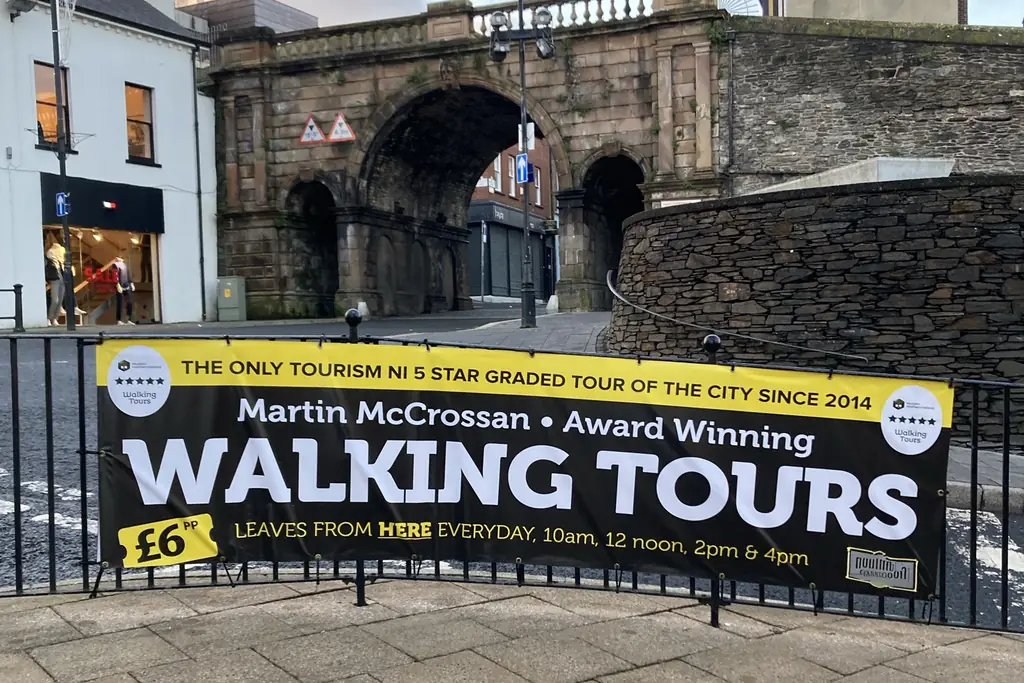
Walking the walls is free and open at any time. If you want the story from someone who grew up inside them, I would suggest the public walking tour with Martin McCrossan City Tours. It runs every day, it takes about an hour, and you do not need to book. The details are in the box below, and Visit Derry lists everything else that is on in the city.
Visitor information
The walls: Free and open at all times. You can climb up at any of the gates, and Shipquay Gate, beside the Guildhall, is the easiest place to start.
Guided walk: Martin McCrossan City Tours, the walking tour of the city with a Tourism NI five star grade. It leaves every day from 11 Carlisle Road, BT48 6JJ, beside level 4 of Foyleside Shopping Centre, at 10am, 12 noon, 2pm and 4pm from March to November, and at 12 noon and 2pm in January and February.
Price: £6 per adult, and children 12 and under go free. There is no need to book, you just turn up.
The Guildhall and the Peace Bridge
Just outside the walls at Shipquay Gate stands the Guildhall, a red sandstone building completed in 1890 and rebuilt after a fire in 1908. Its stained glass windows tell the story of the city, and it is free to walk in and look around.
While you are there, I would also suggest the guided tour of the Guildhall. It is really cheap and a very good experience, and you can book it online, by email or on the day.
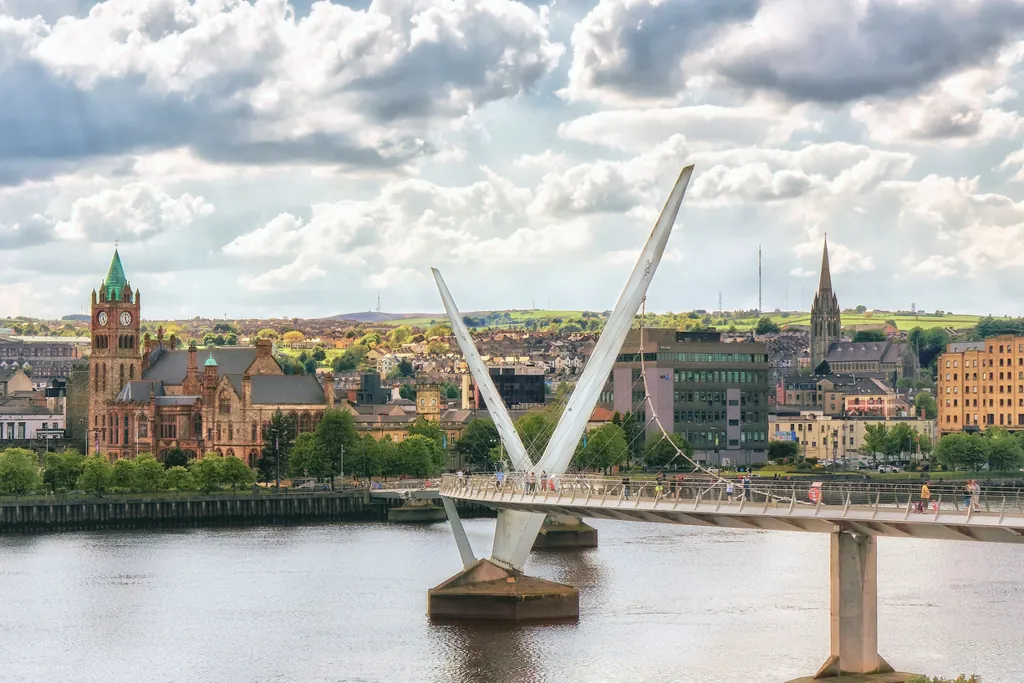
Behind it, the Peace Bridge curves across the River Foyle. It opened on 25 June 2011, a footbridge and cycle bridge of about 770 feet, joining the city centre on the west bank to Ebrington Square on the east, a former army barracks that is now an open public square used for concerts and events. Walk across and back for the best view of the walls and the old city.
Visitor information
The Guildhall: Guildhall Square, BT48 6DQ, just outside Shipquay Gate. Free to go in. Open Monday to Friday from 9am to 8pm and at weekends from 9am to 6pm, with last entry an hour before closing.
Guided tour: Every day at 11am and 2pm, £3 per person. Book online, by email at guildhall@derrystrabane.com, or on the day at the Guildhall.
The Peace Bridge: Starts behind the Guildhall at the river. Free to walk and open at all times, about 770 feet across to Ebrington Square.
St Columb’s and St Eugene’s Cathedrals
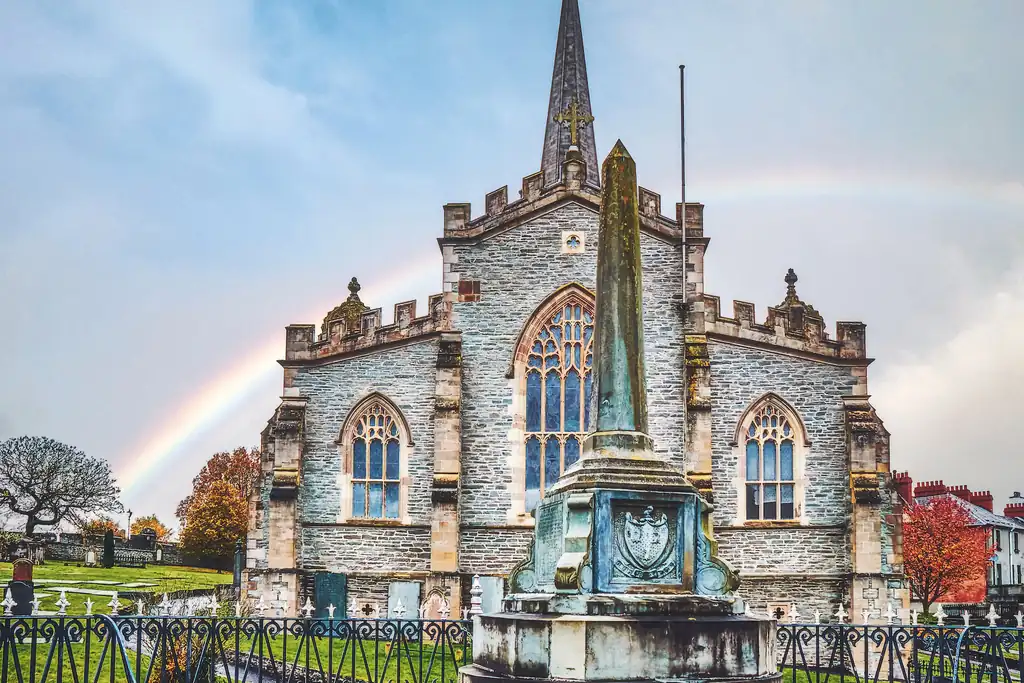
Inside the walls, St Columb’s Cathedral was finished in 1633, the first cathedral built in Britain or Ireland after the Reformation. The chapter house holds relics of the siege of 1689, including the hollow cannonball fired into the city carrying the terms of surrender, which the city refused.
Outside the walls, St Eugene’s Cathedral is the Catholic cathedral of the city. Work began on it in 1849, it opened in 1873, and the spire was finally finished in 1903. The two cathedrals face each other across the city, one on each side of the old divide.
Visitor information
St Columb’s Cathedral: London Street, BT48 6RQ, inside the walls. Its opening days change with the season, and tickets can be booked online, so check before you go.
St Eugene’s Cathedral: Creggan Street, just outside the walls on the north west side of the city.
The Bogside, Free Derry Corner and the Museum of Free Derry
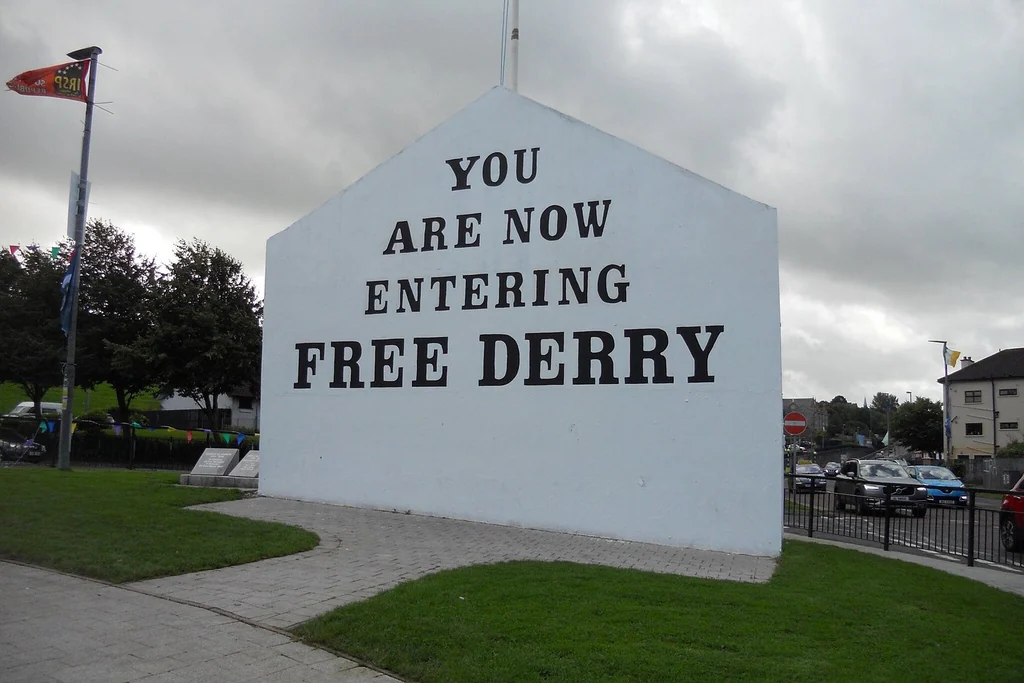
Below the walls on the west side is the Bogside, the nationalist district where the civil rights marches, the Battle of the Bogside and Bloody Sunday all took place. The gable wall of Free Derry Corner, painted with the words You Are Now Entering Free Derry in January 1969, still stands at the heart of it, and the murals of the People’s Gallery run along Rossville Street.
The Museum of Free Derry, beside Free Derry Corner, tells the story of the civil rights era and of Bloody Sunday, 30 January 1972, when soldiers opened fire on a civil rights march and fourteen people died. It is a powerful, careful museum and worth an hour of your time.
You can walk the Bogside on your own, and it is safe to do so, but a local guide makes far more sense of what you are looking at.
Visitor information
Museum of Free Derry: 55 Glenfada Park, BT48 9DR. Open on weekdays from 9.30am, until 6pm from March to October and 5pm the rest of the year, and at weekends from 10am to 4pm. Last entry is an hour before closing.
Tickets: Adult £10, student £7 and concession £8. Children 12 and under go free with their family. You can book online in advance or pay at the desk.
Free Derry Corner: Where Lecky Road meets Fahan Street, below the walls on the Bogside side. Free to see at any time.
The Derry Girls Mural
Derry Girls, the comedy about four schoolgirls and one wee English fella growing up in Derry in the 1990s, has brought a whole new crowd to the city. The best known stop is the Derry Girls mural on the gable end of Badgers Bar on Orchard Street, a couple of minutes from the walls, and it is rarely without someone taking a photograph in front of it.
Many of the streets used in the show are in and around the city centre, so a walk round Derry with the series in mind is easy to do on your own.

Visitor information
Where it is: Orchard Street, on the side of Badgers Bar, opposite Foyleside Shopping Centre and a couple of minutes from the walls. Free to see at any time.
Derry Girls tour: Martin McCrossan City Tours also runs a Derry Girls walking tour on Saturdays from April to October. It takes about 90 minutes, costs £10 per adult, children under 12 go free, and it must be booked in advance.
Getting to Derry and How Long to Stay
Derry is about 70 miles from Belfast, around an hour and a half by the A6. The train from Belfast Grand Central takes a little over two hours, and the last stretch, along the shore of Lough Foyle between Castlerock and Derry, is one of the loveliest rail journeys in Ireland. City of Derry Airport is about 20 minutes from the centre.
Coming along the Causeway Coastal Route, Derry is the end of the road, about 40 minutes past Mussenden Temple. That is why so many people arrive here tired at the end of a coast day. If you can, give Derry a day of its own, or stay the night and drive the coast back the next morning.
One full day covers the walls, the Guildhall, the Peace Bridge, the Bogside and a cathedral. Two days lets you add the museums properly and a trip over the border into Donegal.

When to Visit Derry
Derry is open all year, and most of what is worth seeing is outdoors and free. May to September gives you the longest days and the best chance of dry weather for the walls.
The big event of the year is Halloween. Derry turns the whole city over to it at the end of October, with parades, fireworks over the Foyle and the walls lit up, and it draws huge crowds. Book your room well ahead if you want to be here for it.
Where to Stay in Derry
The best place to stay is inside or right beside the walls, so you can walk everywhere. The Bishop’s Gate Hotel, in an Edwardian building inside the walls, the Shipquay Hotel beside the Guildhall, and the Maldron Hotel inside the walls are all in the heart of the old city.
If you are driving, check the parking before you book. Space inside the walls is tight, and most hotels there have limited or no parking of their own.
Where to Eat in Derry
For dinner, Browns in Town on Strand Road is the restaurant I would suggest. It is a short walk from the walls, the food is local and seasonal, and it is worth booking a table ahead, especially at the weekend.
Inside the walls and around the Guildhall you will find plenty of cafés and pubs for lunch or a coffee between the sights, so there is no need to plan the middle of the day in advance.
Things to Do in Derry FAQ
What are the best things to do in Derry?
Walk the city walls, see the Guildhall and cross the Peace Bridge, visit St Columb’s Cathedral, and spend time in the Bogside with the murals, Free Derry Corner and the Museum of Free Derry.
Can you walk the Derry walls?
Yes, the full circuit of about a mile is open on top of the walls at any time, and it is free. Most people walk it in under an hour.
Is there a Derry walls walking tour?
Yes. Guided walks of the walls run from the city centre most days in season, and they take about an hour.
How long are the Derry walls?
About a mile all the way round the old city. They were built between 1613 and 1619 and have never been breached.
What are the best things to do in Derry city centre?
The walls, the Guildhall, the Tower Museum, St Columb’s Cathedral, the Peace Bridge and the Derry Girls mural on Orchard Street are all within a short walk of each other.
What are the best things to do in Derry with kids?
Walking the walls and spotting the old cannon, crossing the Peace Bridge, and the open space of Ebrington Square on the far side. At Halloween the whole city puts on a show.
Where is the Derry Girls mural?
On the gable end of Badgers Bar on Orchard Street, a couple of minutes from the walls in the city centre.
Is the Bogside safe to visit?
Yes. The Bogside is a residential area that visitors walk through every day to see the murals, Free Derry Corner and the Museum of Free Derry.